You Didn’t Just Gain Weight. Here’s What Your Body Actually Built.

Pregnancy weight gain can mess with your head.
Even when you know you are growing a baby. Even when you know weight gain is expected and necessary (to an extent). Even when you know your body is doing something genuinely extraordinary.
Because when the scale keeps climbing, week after week, trimester after trimester, it is easy to start wondering:
How am I gaining so much fat?
The answer is that it isn’t that…”just fat”. And the full answer is also more nuanced than “Omg girl, you’re pregnant duh.”
The CDC confirms that healthy pregnancy weight gain depends on pre-pregnancy BMI, and that appropriate gain matters for the health of both mother and baby, not just for the delivery, but for long-term outcomes on both sides. The recommended ranges are not random. They are based on body size, pregnancy type, and real physiological data.
But those numbers on the scale? They represent a lot more than most people realize. This article is a full, number-backed breakdown of what is actually happening inside your body: where the weight comes from, what it is doing, and why the human body is genuinely, seriously cool for doing all of it simultaneously…or really at all.
Pregnancy Weight Gain Is Not Just One Thing
The most important thing to understand about pregnancy weight gain is that it is not a single number representing a single thing. It is a combination of several distinct biological processes all happening at once, each with its own purpose and its own contribution to the total on the scale.
According to the National Academies of Sciences review on gestational weight gain, pregnancy deposits protein, fat, water, and minerals across the fetus, placenta, amniotic fluid, uterus, mammary glands, blood, and adipose tissue, and the products of conception alone (the baby, placenta, and amniotic fluid) account for approximately 35% of total gestational weight gain.
Let that land for a second. A third of the weight you gain in pregnancy is baby, placenta, and fluid. And the other two-thirds? Also not “just fat.”
“The scale is not just measuring fat. It is measuring an entire pregnancy system being built.”
Important: Pregnancy weight-gain ranges are medical guidelines, not moral categories. They exist to support the health of both you and your baby, not to pass judgment on your body.
How Much Weight Gain Is Usually Recommended?
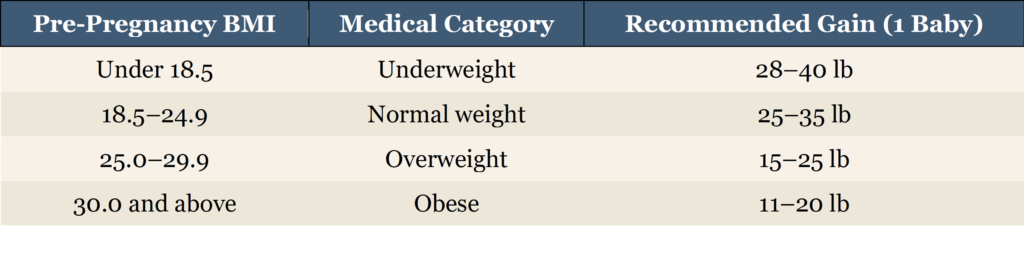
The amount of weight recommended during pregnancy is not one-size-fits-all. It is based on your pre-pregnancy BMI. The following ranges come from the Institute of Medicine (IOM), published by the CDC, and represent the evidence-based targets used in standard prenatal care for singleton pregnancies (CDC, 2024):
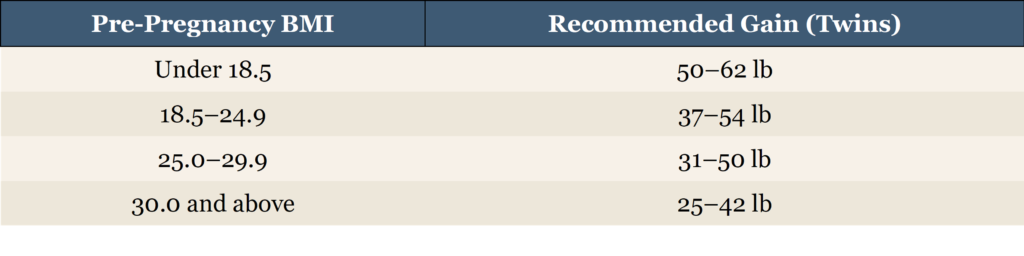
For twin pregnancies, the recommended ranges are higher to account for the additional baby, placenta, and fluid:
Important: These are population-based medical ranges, not moral categories. Your doctor should help you interpret them based on your pregnancy, health history, baby’s growth, and individual situation.
Where Does Pregnancy Weight Actually Go?
Most pregnant women see 25–35 pounds on the scale and assume that number represents 25–35 pounds of fat. It does not, not even close.
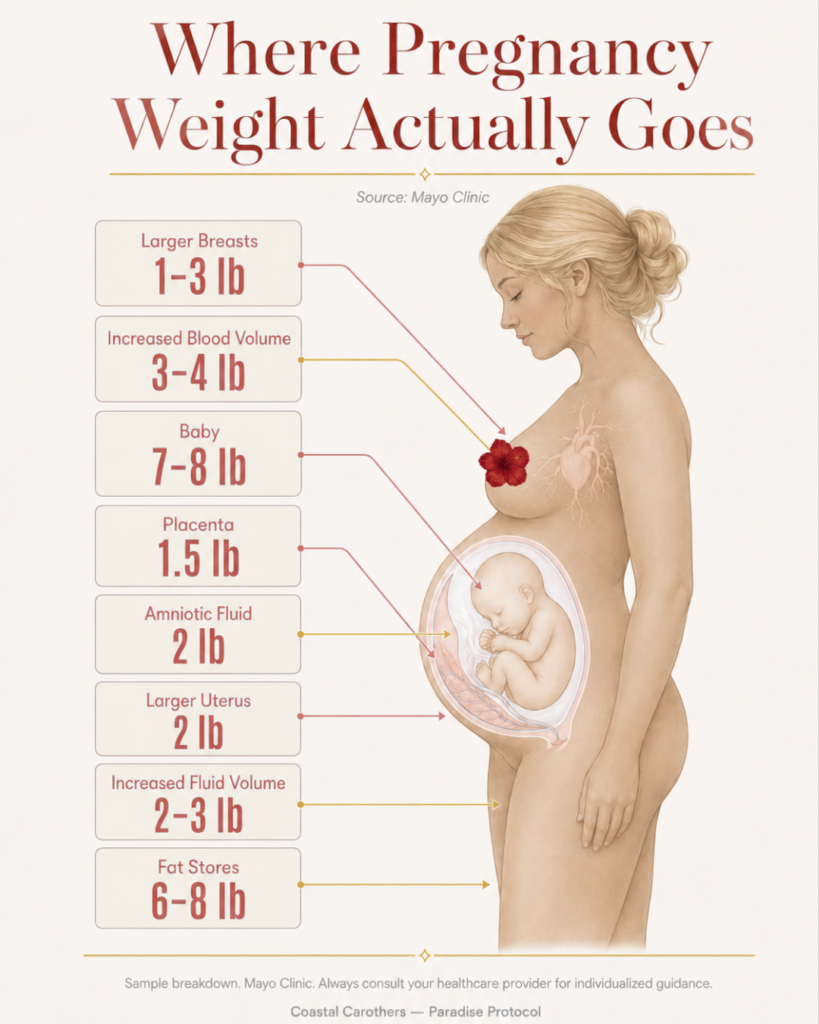
Mayo Clinic’s sample breakdown of pregnancy weight gain shows exactly where those pounds are distributed across a healthy singleton pregnancy:
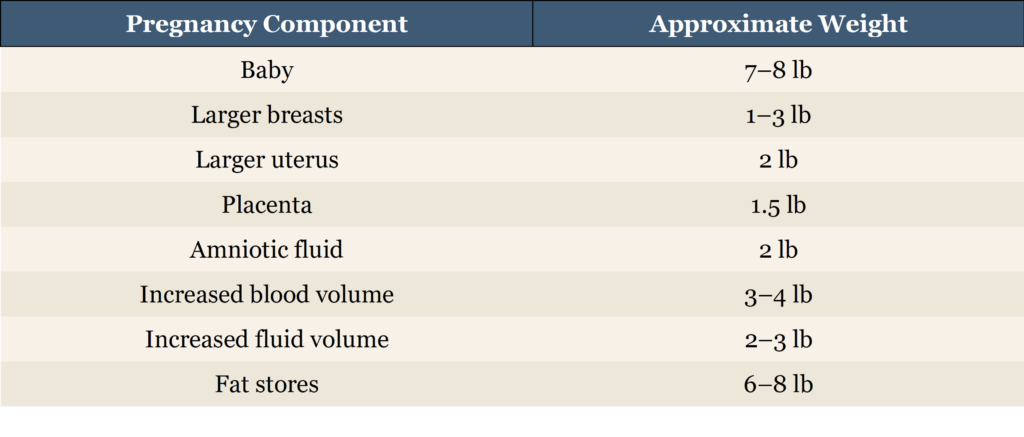
Add those up and you’re looking at roughly 22–31 pounds of weight that is entirely accounted for by biological necessity. The scale is not just keeping score of what you ate. It is tracking an entire pregnancy being built inside you.
“You didn’t just gain weight. Your body is building a placenta, expanding blood volume, growing a uterus, storing energy, holding fluid, and growing an entire human.”
What Each Part of Pregnancy Weight Gain Actually Does
Here is the breakdown of each component: what it is, what it does, and why it matters:
Baby
The most visible reason for pregnancy weight gain, and often the only one people think about. According to Mayo Clinic’s sample breakdown, a full-term baby weighs approximately 7–8 pounds at delivery. That accounts for a meaningful portion of the total, but it is far from the only portion.
Placenta
The placenta is a temporary organ your body creates specifically to support your baby. It delivers oxygen and nutrients, removes waste products, produces pregnancy hormones, and acts as a buffer between the maternal and fetal blood supply. Mayo Clinic lists the placenta at approximately 1.5 pounds in its sample breakdown. That is an entire organ your body built from scratch. Seriously crazzzzzzy.
Amniotic Fluid
The amniotic fluid cushions and protects your baby, supports fetal movement for muscle and bone development, regulates temperature, and helps with lung development. Mayo Clinic lists it at approximately 2 pounds. The National Academies review notes that amniotic fluid volume varies and can affect maternal gestational weight gain by as much as about 1 kilogram (about 2.2 pounds) at term.
Uterus Growth
Before pregnancy, your uterus weighs approximately 2 ounces. By the end of pregnancy, it expands enough to hold a full-term baby, placenta, and amniotic fluid, gaining approximately 2 pounds in the process. That kind of structural expansion is entirely overlooked when people think about pregnancy weight gain, and it shouldn’t be.
Breast Tissue
Breast changes are one of the earliest signs of pregnancy and continue throughout. The breast tissue growth you experience is your body preparing for breastfeeding, glandular tissue proliferates, milk ducts expand, and supportive tissue increases. Mayo Clinic lists this at approximately 1–3 pounds in its sample breakdown. And I swear it can end up being 10 pounds LOL (at least that’s what it feels like).
Blood Volume
This is one that surprises people: your blood volume increases dramatically during pregnancy to support fetal circulation, oxygenate both you and your baby, and prepare for blood loss during delivery. The National Academies review describes plasma volume expansion increasing approximately 45–50% during pregnancy. Mayo Clinic lists this increased blood volume at approximately 3–4 pounds in its sample breakdown. You are literally carrying more blood than a non-pregnant person. How cool is that?
Fluid Volume
Extra extracellular fluid is a normal and expected part of pregnancy. Mayo Clinic lists increased fluid volume at approximately 2–3 pounds. The National Academies review describes total body water accretion averaging approximately 7–8 liters across healthy pregnancies, water distributed across the fetus, placenta, amniotic fluid, uterus, mammary gland, blood, and extracellular fluid. Some of that “water weight” people notice? It has a purpose.
Fat Stores
Here is where my nuance comes in, because this section deserves honesty.
Some fat storage is a completely normal and an expected part of pregnancy. Mayo Clinic lists typical fat stores at approximately 6–8 pounds in its sample breakdown. These stores exist for a reason: they provide energy for labor, delivery, and breastfeeding. They are not random. They are strategic.
But this does not mean unlimited fat gain is automatically biologically necessary. Some of those fat stores come from normal metabolic changes. Some may come from consistent calorie overconsumption, cravings, binge eating, or “eating for two” in a literal sense. I know I did this time around. Lol
Both things are allowed to be true at once: fat gain is a normal part of pregnancy, and the amount you gain is still something you can discuss honestly and without shame with your provider.
Yes, Some Fat Gain Is Normal, But That Doesn’t Mean Every Pound Is “Required”
I want to be direct here, because I think this is the part that actually helps people.
Pregnancy requires weight gain. Pregnancy often includes fat storage. But pregnancy does not mean nutrition no longer matters.
The CDC recommends working with a healthcare provider on weight-gain goals, comparing progress to recommended ranges, eating a balanced diet, and limiting added sugars and solid fats from foods such as soft drinks, desserts, fried foods, whole milk, and fatty meats. Mayo Clinic also notes that gaining too much during pregnancy can increase a baby’s risk of health concerns, and can increase the mother’s risk of postpartum weight retention.
This is not about shaming cravings. This is not about obsessing over the scale during one of the most physically demanding seasons of your life. This is also not about pretending that binge eating, daily overindulging, or gaining significantly beyond the recommended range is never worth discussing.
You are allowed to be kind to yourself and still be honest about your habits. Those are not in conflict.
“Pregnancy is not the time for shame, but it is also not the time to stop caring for your body.”
Reminder: Some fat storage is a normal part of healthy pregnancy. Excessive gain is still something you can discuss with your provider without shame and many providers will proactively bring it up as part of routine prenatal care.
Why Pregnancy Weight Gain Can Feel Scary
Even with all this research laid out, it is completely normal for pregnancy weight gain to feel emotionally overwhelming. And I want to acknowledge that before we move forward.
The scale moving faster than usual. Clothes not fitting. Your face, breasts, belly, hips, and thighs changing. Your body feeling like it is moving in a direction you did not fully consent to. The fear that none of it will feel familiar again on the other side. Not knowing what is “normal” and what is not.
These feelings are valid. They do not make you shallow or ungrateful. They make you human.
What can help is understanding the timing. Most people do not need significant weight gain in the first trimester. Mayo Clinic says people starting at a healthy weight generally need only about 1–4 pounds in the first few months, with steadier gain becoming more important in the second and third trimesters. The CDC breaks down caloric needs by trimester: the first trimester generally does not require extra calories, the second trimester typically calls for approximately 340 additional calories per day, and the third trimester calls for approximately 450 extra calories per day.
That is not “eating for two.” That is eating for you, plus the equivalent of about half a sandwich and a glass of milk.
Reminder: Your body changing quickly does not mean your body is failing. It means pregnancy is physically demanding, hormonally complex, and constantly shifting. You are not losing control. You are growing a person.
What About Weight Gain From Cravings, Binge Eating, or “Eating for Two”?
Let’s be honest about this, because pretending it doesn’t happen doesn’t serve anyone.
Some pregnancy weight gain comes from the biological needs covered above. Some can come from extra calories, food cravings, binge eating, emotional eating, nausea management with carb-heavy foods, or a significant drop in physical activity. Both can be true at the same time.
Pregnancy can make hunger, cravings, nausea, exhaustion, stress, and food decision-making genuinely harder to navigate. That is real and it deserves acknowledgment, not judgment, but if you feel out of control with food habits or worried about your rate of gain, your doctor can help you make a realistic, compassionate plan. That is exactly what they are there for.
The CDC recommends balanced eating, appropriate caloric increases by trimester, and working with a provider to track pregnancy weight gain goals. That kind of support is not about restriction, it is about having a plan that takes care of both you and your baby.
You are allowed to be kind to yourself and still be honest about your habits.
If you want a solid starting point for thinking about protein and nutrition during pregnancy, High Protein Snack Foods That You Can Grab & Go and Understanding Macros Made Simple are both good resources to explore with your provider’s guidance.
“You are allowed to be kind to yourself and still be honest about your habits.”
When Weight Gain Is Worth Bringing Up With Your Doctor
Most pregnancy weight gain is completely normal. But some changes warrant a conversation with your healthcare provider sooner rather than later. Bring it up if:
• You are gaining significantly faster than expected
• You are gaining far above or below your recommended range
• You feel out of control with eating and want support
• You are restricting food out of fear of weight gain
• You have sudden or significant swelling in your hands, face, or legs
• You notice a sudden jump on the scale (2–5 pounds in a week)
• You have persistent headaches that will not go away
• You have vision changes, upper-right abdominal or shoulder pain, or trouble breathing
That last cluster of symptoms is important. March of Dimes lists these as warning signs of preeclampsia, a serious pregnancy condition involving high blood pressure, and advises calling a provider right away if they appear. They specifically note sudden weight gain of 2–5 pounds in a week as a possible warning sign, along with swelling in the legs, hands, or face, persistent headache, vision changes, upper-right belly or shoulder pain, and trouble breathing.
Call your provider: Sudden weight gain with swelling, headache, vision changes, upper-right belly pain, or trouble breathing should be taken seriously and addressed immediately. These can be signs of preeclampsia.
FAQ: Pregnancy Weight Gain
Is pregnancy weight gain just baby weight?
No. The baby is only one part. It also includes the placenta, amniotic fluid, uterus growth, breast tissue, increased blood volume, increased fluid volume, and maternal fat stores. The baby typically accounts for about 7–8 pounds of a total 25–35 pound gain in a normal-weight pregnancy.
How much of pregnancy weight gain is fat?
Typical fat stores make up about 6–8 pounds in pregnancy weight-gain breakdowns. This is a normal and expected part of pregnancy, though the total amount of fat gain varies significantly by individual eating habits, activity level, and metabolic factors.
Is fat gain during pregnancy normal?
Yes. Some fat storage is part of normal pregnancy weight gain and serves a real purpose: it fuels labor, delivery, and breastfeeding. But gaining excess fat from consistently eating far beyond your needs is still something you can discuss with your provider without shame.
How much weight should I gain during pregnancy?
It depends on your pre-pregnancy BMI and whether you are carrying one baby or multiples. The CDC lists 25–35 pounds for a singleton pregnancy in the normal BMI range, with different ranges for underweight, overweight, and BMI 30+ categories (CDC, 2024). Always work with your specific provider on your personal goal.
Do I need extra calories in the first trimester?
Usually, no. The CDC says the first trimester generally does not require extra calories. Typical additional caloric needs are approximately 340 calories per day in the second trimester and approximately 450 extra calories per day in the third trimester.
When should I worry about sudden weight gain?
Sudden weight gain, especially with swelling, headache, vision changes, upper-right abdominal pain, or trouble breathing, should be discussed with a healthcare provider promptly. March of Dimes lists sudden gain of 2–5 pounds in a week as a possible warning sign of preeclampsia.
Final Thoughts

Pregnancy weight gain is not always easy emotionally, but it is easier to process when you know what is actually happening inside your body.
You are not just “getting bigger.” Your body is building:
• A baby
• An entirely new organ (the placenta, built from scratch, just for this pregnancy)
• Nearly twice your normal blood supply
• 7–8 liters of additional body water
• A dramatically expanded uterus
• Breast tissue preparing for breastfeeding
• Energy reserves for one of the most physically demanding events of your life
And if you are gaining more than feels right, or you feel out of control with food during this season, that does not make you a bad mom. It makes you someone who deserves honest support and a real plan. You are allowed to ask your doctor for that without shame.
The scale is giving you a number. Not the whole story.
“You didn’t just gain weight. You built an entire support system for another human.”
And when you’re ready to think about the other side of this conversation, I’ll have more on it in Dieting While Pregnant: My Unpopular Opinion, coming soon.
If this helped you understand your pregnancy body a little better, save it, share it with a pregnant friend who needs to hear it, and remember: your body knows what it’s doing, even when the scale doesn’t feel like it.
Short on time? Pin it for later! 🌅📌

Sources
- Centers for Disease Control and Prevention. “Weight Gain During Pregnancy.” CDC, 15 May 2024, www.cdc.gov/maternal-infant-health/pregnancy-weight/index.html.
- March of Dimes. “Preeclampsia.” March of Dimes, www.marchofdimes.org.
- Mayo Clinic Staff. “Pregnancy Weight Gain: What’s Healthy?” Mayo Clinic, www.mayoclinic.org/healthy-lifestyle/pregnancy-week-by-week/in-depth/pregnancy-weight-gain/art-20044360.
- National Academies of Sciences. “Composition and Components of Gestational Weight Gain: Physiology and Metabolism.” Weight Gain During Pregnancy: Reexamining the Guidelines, NCBI Bookshelf, www.ncbi.nlm.nih.gov/books/NBK32815/.