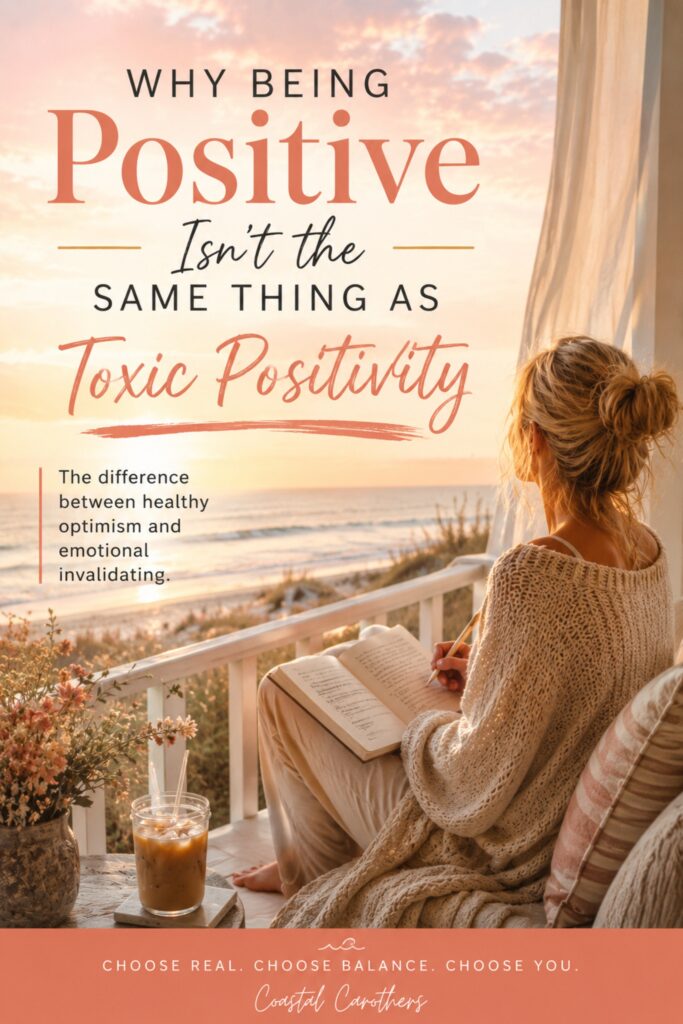
Why Being Positive Isn’t the Same Thing As Toxic Positivity

When Did Positivity Become a Red Flag?
Somewhere along the way, positivity stopped being seen as uplifting and started being treated like a personality flaw.
“Toxic positivity” became a massive internet buzzword. And with it came something I genuinely did not see coming: optimism being treated as suspicious. Positive people being labeled fake, naive, emotionally unaware, or just straight-up annoying for having the audacity to look at the bright side.
It’s confusing that positivity has become something people are suspicious of.
For me, positivity is a conscious choice. It’s not an accident or a personality quirk I was born with, it’s something I actively work toward because I know what the alternative looks like from the inside. Choosing to see the best in people, choosing to find a silver lining, choosing to protect my mental health by refusing to let every hard thing consume me, that is not toxic. That is intentional.
Research from the American Psychological Association and Mayo Clinic both support what many positive people already understand intuitively: optimistic thinking is genuinely linked to better stress management, healthier coping behaviors, and improved emotional well-being. Positive reframing isn’t avoidance, it’s a recognized adaptive coping strategy used in Cognitive Behavioral Therapy, stress management, and resilience training. It has been studied extensively. It works.
So the idea that positivity itself is a problem? I have thoughts.
What Toxic Positivity Actually Means
Before I get into my feelings about how the phrase gets misused, I want to be clear: toxic positivity is a real thing. I’m not here to pretend it isn’t. My argument is that people are overusing and misapplying the phrase, not that the concept doesn’t exist.
The actual definition of toxic positivity is: the excessive or forced promotion of positive thinking while dismissing, suppressing, minimizing, or invalidating genuine negative emotions.
Classic examples include things like:
- “Just stay positive!” {Said to someone actively grieving}
- “Others have it worse” {Used to dismiss real pain}
- “Everything happens for a reason” {In response to trauma or loss}
- “Don’t be sad” or “good vibes only” {When someone is in genuine distress}
Research on emotional suppression confirms what clinical psychologists have observed for years: consistently ignoring or suppressing negative emotions doesn’t resolve them. It often increases stress, anxiety, and emotional distress instead. Emotional validation: the act of actually acknowledging what someone feels, strengthens emotional regulation, social connection, and psychological safety. It matters.
So yes. When positivity is used as a weapon to shut down someone’s real pain? That’s a problem. Absolutely.
But here’s where I need to make the distinction very clear:
Positivity itself is not toxic.
Forcing positivity while refusing to acknowledge emotional reality can be.
Those are two entirely different things. And conflating them is where a lot of the internet has gone sideways.
Being Positive and Being Emotionally Invalidating Are Not the Same Thing

Trying to comfort someone is not automatically toxic. Offering encouragement is not manipulation. Wanting to help someone feel better is not the same as dismissing what they’re going through.
Emotionally intelligent positivity acknowledges the feeling first. It doesn’t skip over the pain. It doesn’t rush to the silver lining before the person feels heard. There’s a massive difference between these two responses:
Ex 1: “Don’t be sad, everything happens for a reason.”
Ex 2: “This situation really sucks, and you have every right to feel this way. I just don’t want you to lose yourself in it.”
One dismisses. One validates and still offers hope. Both involve positivity. Only one is actually toxic.
Other examples of positivity that are emotionally intelligent, not dismissive:
- “You’re allowed to cry, vent, and be angry. I just also want to remind you that this moment won’t define your entire life.”
- “I know things feel awful right now, but I’m here with you.”
- “I completely understand why you feel this way. I just want to help you find a little hope again when you’re ready.”
- “Girl, complain all you want. Then we’re getting Taco Bell and getting your mindset right.”
Wanting to see the bright side of a situation doesn’t mean someone is denying reality. Sometimes it means they’re trying to survive it.
Mental health professionals describe healthy emotional support as a balance between validation, empathy, encouragement, and perspective, not a choice between emotional honesty and hope. You can hold space for someone’s pain and still be the person who reminds them it won’t be this way forever. That is not toxic. That is actually what good support looks like.
Sometimes People Just Want to Vent, And That’s Completely Valid
Here’s a nuance I genuinely believe in, and I want to say it clearly because it’s important.
Sometimes I don’t want real advice. I don’t want a solution. I don’t want perspective. I want to vent about something stupid and irritating and have someone just agree with me.
And in those moments, “girl, I’m just bitching right now, bitch with me” is the single most helpful thing you can communicate.
Because the issue isn’t the positivity. The issue is the timing.
Emotional validation is genuinely important. Research consistently confirms it strengthens emotional regulation, social connection, and psychological safety. Sometimes what someone needs is not a silver lining, it’s just: “girl… same.”
And that makes total sense. I get it. I live it. The fix is simple: just let people know what you need. If you want to bitch and you have a positive friend who immediately goes into solution mode, that’s a communication issue, not a toxicity issue.
However, and this matters, there is a difference between healthy venting and what psychology calls co-rumination. Co-rumination is the excessive, repetitive cycling through the same problems over and over. Dwelling on negativity, reinforcing distress, revisiting pain without any movement toward resolution. Research has linked chronic co-rumination to higher anxiety, depressive symptoms, and emotional exhaustion, and it appears with higher frequency in female friendships.
Venting for ten minutes and moving on is healthy. Spending every conversation marinating in the same problems for months, with a friend who only validates and never gently challenges, that’s a different dynamic. And that one is not actually serving you.
The Internet Has Started Treating Positivity Like It’s Fake

It is strange that we have reached a point where someone trying to spread encouragement or hope is automatically viewed with suspicion.
I have seen people complain that a friend was “too positive” like it was a character flaw. I have heard “it’s so annoying how she’s positive all the time” said about someone who was literally just trying to spread good energy. And every time I hear it, I think the same thing:
Why would you want less of that?
Being told you are “too positive” is genuinely hurtful when positivity is something you work hard to maintain. It is a conscious energy that some people choose to put into the world. To be criticized for it, or to have people complain to others about how annoying your good energy is, is honestly, ass backwards.
Part of what’s driving this is the internet itself. Research on social media engagement and emotional contagion shows that negative content tends to generate stronger reactions and higher engagement online. Over time, this creates an environment where cynicism, outrage, and negativity-heavy communication styles get amplified and normalized. Positivity, by comparison, can start to look performative or naive simply because it doesn’t perform as well in a culture that’s algorithmically rewarding drama.
The “toxic positivity” culture that has flourished online is, at its core, a reflection of how normalized negativity has become. And I’d like to be clear that I’m not talking about people who are going through something real. I’m talking about the people who seem to be offended by the existence of someone else’s good energy. Those are not the same people. We don’t love to see it.
In my experience, the loudest critics of “toxic positivity” are usually not processing genuine grief or trauma. They’re often the ones who want people around them to agree with everything, who default to negativity, and who find optimism threatening in a way that says more about them than it does about the positive person in front of them. That’s not a mental health stance. That’s insecurity dressed up in psychological language.
There’s a Difference Between Supporting Someone and Enabling Them
Now here’s where I want to give the phrase “toxic positivity” some real credit, because there is a version of it that I think is genuinely worth naming.
When someone cheers on or makes light of genuinely harmful decisions in the name of “support”, that is toxic. That is the version of positivity that actually causes damage.
Convincing someone to see the “positives” of a drinking habit that is clearly leading somewhere bad. Hyping up a bad decision because you don’t want to be the one who says something honest. Encouraging someone’s self-destructive patterns because confronting them feels uncomfortable. That is not support. That is enabling and sometimes it is manipulative, whether or not it’s intentional.
Psychology defines enabling as behavior that unintentionally supports or reinforces unhealthy patterns by removing accountability or minimizing consequences. Healthy relationships balance compassion, honesty, and accountability. They don’t just tell people what they want to hear.
Sometimes the most loving thing you can do is encourage growth instead of encouraging destruction.
That is not toxic positivity. That is the absence of it.
Choosing Positivity Is Not Weakness
I want to say this for every woman who has ever been made to feel like her optimism is a character flaw:
Some people aren’t positive because life has been easy. They’re positive because they know how dark life can get.
Choosing positivity often requires emotional discipline. It means actively refusing to let spiraling thoughts take over. It means protecting your mental state with intention because you’ve been inside the spiral before and you know exactly what it costs you.
Optimism is not naive. It is not performative. It is not a sign that someone is out of touch with reality. Research in positive psychology shows that gratitude practices and positive cognitive reframing genuinely improve emotional resilience, stress management, and overall well-being. And research on chronic rumination, the repetitive negative thought cycling that happens when people dwell on worst-case scenarios, consistently links it to anxiety, depressive symptoms, and emotional exhaustion.
In other words: the thing positive people are actively choosing not to do? Has documented consequences. Let them keep choosing not to do it.

Final Thoughts
Emotional honesty matters. Difficult emotions deserve space. None of that is in question here.
What I am saying is that positivity is not the enemy. Choosing to see hope in hard situations is not manipulation. Wanting to feel better is not the same as avoiding reality. And being a person who consistently brings good energy into the world is not something that deserves an eye roll.
Emotional intelligence includes both acknowledging pain and allowing hope. Those are not opposites. They are not in conflict. They belong together.
And if someone in your life is consistently positive, consistently encouraging, and consistently trying to help you see the best in things, maybe instead of calling them toxic, ask yourself why their energy bothers you.
There’s a difference between denying reality and refusing to let negativity consume your entire life.
One of those is a problem. The other one is a choice worth protecting.
If this resonated, save it or share it with a positive person in your life who deserves to hear it. And if you’ve ever been told you’re “too positive”…stay that way. I’ll be right there with you.
Short on time? Pin it for later! 🌅📌

Sources
- American Psychological Association. “Building Your Resilience.” American Psychological Association, www.apa.org/topics/resilience/building-your-resilience.
- Cherry, Kendra. “What Is Toxic Positivity?” Verywell Mind, Dotdash Meredith, 7 Feb. 2025, www.verywellmind.com/what-is-toxic-positivity-5093958.
- Cuncic, Arlin. “How Emotional Validation Improves Relationships.” Verywell Mind, Dotdash Meredith, 14 Jan. 2025, www.verywellmind.com/what-is-emotional-validation-425336.
- Ford, Brett Q., et al. “The Psychological Health Benefits of Accepting Negative Emotions and Thoughts.” Journal of Personality and Social Psychology, vol. 115, no. 6, 2018, pp. 1075–1092.
- Fredrickson, Barbara L. Positivity. Crown Publishers, 2009.
- Linehan, Marsha M. DBT Skills Training Manual. 2nd ed., Guilford Press, 2014.
- Mayo Clinic Staff. “Stress Symptoms: Effects on Your Body and Behavior.” Mayo Clinic, www.mayoclinic.org/healthy-lifestyle/stress-management/in-depth/stress-symptoms/art-20050987.
- Neff, Kristin. Self-Compassion: The Proven Power of Being Kind to Yourself. William Morrow, 2011.
- Psychology Today Editors. “Emotional Invalidation.” Psychology Today, Sussex Publishers, www.psychologytoday.com/us/basics/emotional-invalidation.
- Seligman, Martin E. P. Learned Optimism. Vintage Books, 2006.