How to Calculate Your Macros: A Beginner’s Guide That Actually Makes Sense
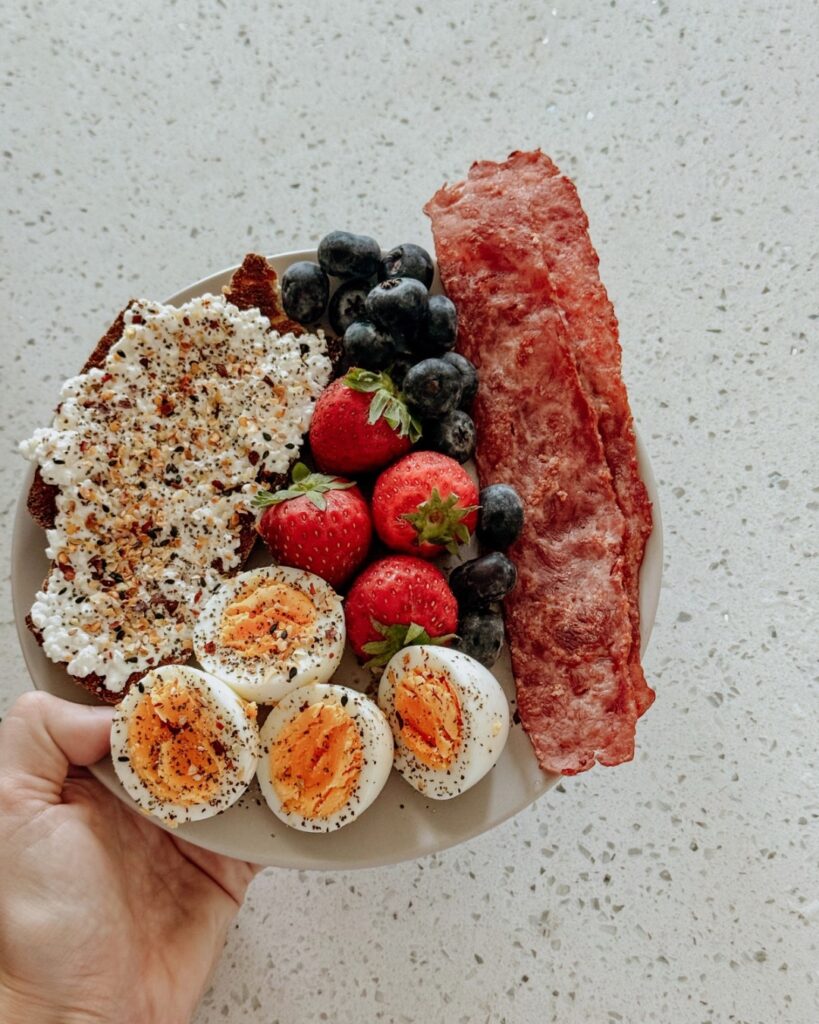
One thing I’ve learned over the years is that nutrition people have a real talent for making simple things sound complicated.
Macros are a perfect example. If you’ve ever tried looking them up online, you’ve probably been hit with enough conflicting information to make you close the tab immediately and go eat a handful of Flaming Hot Cheetos instead.
The funny thing is, once I actually sat down and learned what macros were, they made complete sense. They’re not some secret fitness hack reserved for bodybuilders and athletes. They’re simply protein, carbohydrates, and fat: the three main nutrients your body runs on. That’s it.
I’ve been using the same calculation method for years, adjusting the numbers as my goals shift, and it has never failed me as a starting point.
This guide is going to walk you through exactly how I do it, in plain language, with real examples, and zero unnecessary jargon.
In this article:
• What macros are and what each one does
• How calories fit into the picture
• Why people track macros
• My personal calculation method, step by step
• How to adjust when things aren’t working
• Common beginner mistakes to avoid
• FAQ’s
First Things First: What Are Macros?
“Macros” is short for macronutrients: the nutrients your body needs in large amounts every single day. According to the USDA Food and Nutrition Information Center, macronutrients are the foundation of your diet and the primary source of energy your body uses to function.
There are three of them:
Protein
Protein builds and repairs muscle tissue, supports recovery, produces enzymes and hormones, and keeps you feeling full longer than most other nutrients. Research confirms that adequate protein intake is critical for maintaining lean muscle mass and supporting overall metabolic health across all activity levels.
Sources: chicken, fish, eggs, Greek yogurt, cottage cheese, beef, protein powder, tofu, legumes
Check out my article High Protein Snack Foods That You Can Actually Grab & Go for easy ideas.
Carbohydrates
Carbohydrates are your body’s primary and preferred source of energy. They fuel exercise performance, support brain function, and power you through the demands of daily life. Carbohydrates are the main energy source for the brain and they make up the majority of daily calorie intake.
Sources: rice, oats, fruit, potatoes, bread, pasta, vegetables
Fat
Fat is not the enemy, despite what decades of diet culture may have told you. Fat supports hormone production, brain health, and the absorption of fat-soluble vitamins A, D, E, and K. It also provides a long-lasting energy source and contributes to satiety. Your source is what matters.
Sources: olive oil, avocado, nuts, seeds, eggs, fatty fish, cheese, butter
Note: Macros are not “good” or “bad.” They are simply different tools your body uses. Every macro serves a purpose. Removing one entirely is not necessary and usually not sustainable.
✨ Sidney’s Take: “Macros get an unfair reputation for being complicated. Once you understand what each one actually does, they’re surprisingly straightforward and a lot more helpful than following a diet that just tells you what you can and can’t eat.”
Where Calories Fit Into the Picture
This is where most people get confused, so I want to make it really simple.
Calories are units of energy. Your body needs energy to breathe, move, think, and function. The food you eat provides that energy and that energy comes from macros.
Every gram of every macro you consume contains a specific calorie value:
Protein = 4 calories per gram
Carbohydrates = 4 calories per gram
Fat = 9 calories per gram
This is why fat is more calorie-dense than protein or carbs, not because it’s “worse,” but simply because each gram contains more than twice the calories. It also explains why two foods with identical calorie counts can have completely different effects on your hunger, energy, and body composition.
Calories tell you how much energy you’re eating. Macros tell you where that energy is coming from.
Both pieces of information matter. Neither one alone gives you the full picture.
Why Do People Track Macros in the First Place?
Macro tracking is not reserved for competitive athletes or bodybuilders. Plenty of everyday people including moms, office workers, teachers, runners, people trying to lose weight, people trying to build strength, use macros to take the guesswork out of their nutrition.
For fat loss: Tracking macros creates awareness around how much you’re actually eating, helps you hit a protein goal that protects muscle while losing fat, and makes it easier to stay consistent without feeling completely restricted.
For building muscle: Macros help ensure you’re eating enough total calories and enough protein to actually support muscle growth and recovery from training.
For general health: Even short-term macro tracking teaches you a tremendous amount about the nutritional content of what you eat, which helps you build better habits long after you stop tracking every gram.
That last point is important: macro tracking is a tool, not a forever commitment. I don’t think everyone needs to count macros for the rest of their life. But I do think learning the basics gives you a level of nutritional literacy that changes how you see food permanently.
The Biggest Macro Myth Out There
Myth: macro tracking is only for serious athletes or bodybuilders.
Reality: macros are just a framework for understanding food. Anyone who eats food can benefit from understanding them. The fitness industry has done a spectacular job of making nutrition feel intimidating and macro-tracking super niche, but the fundamentals are genuinely accessible to anyone willing to learn them.
For me personally, learning macros simplified nutrition rather than complicated it. Instead of trying to follow a list of “allowed” and “forbidden” foods, I understood why certain choices made sense for my goals. That shift made everything easier.
Before You Calculate Anything…
A quick but genuinely important note before we get into the numbers.
No formula, calculator, or app can perfectly predict what your body needs. Metabolism, genetics, activity level, stress, hormones, sleep, and lifestyle all affect how your body uses energy and none of those variables are captured in a simple equation. The calculations below are starting-point estimates, not guaranteed results.
What I personally use and recommend are practical coaching multipliers that I’ve worked with for years. They are not peer-reviewed equations. They are a reliable starting framework, one that gives you numbers to work from and adjust over time based on how your body actually responds.
My Simple Macro Calculation Method (Step by Step)
There are thousands of macro calculators online. This is the straightforward method I’ve personally used and recommended for years because it is easy to understand, easy to apply, and easy to adjust. I use it for all three goals: fat loss, maintenance, and muscle gain and simply swap the multiplier based on where I am.
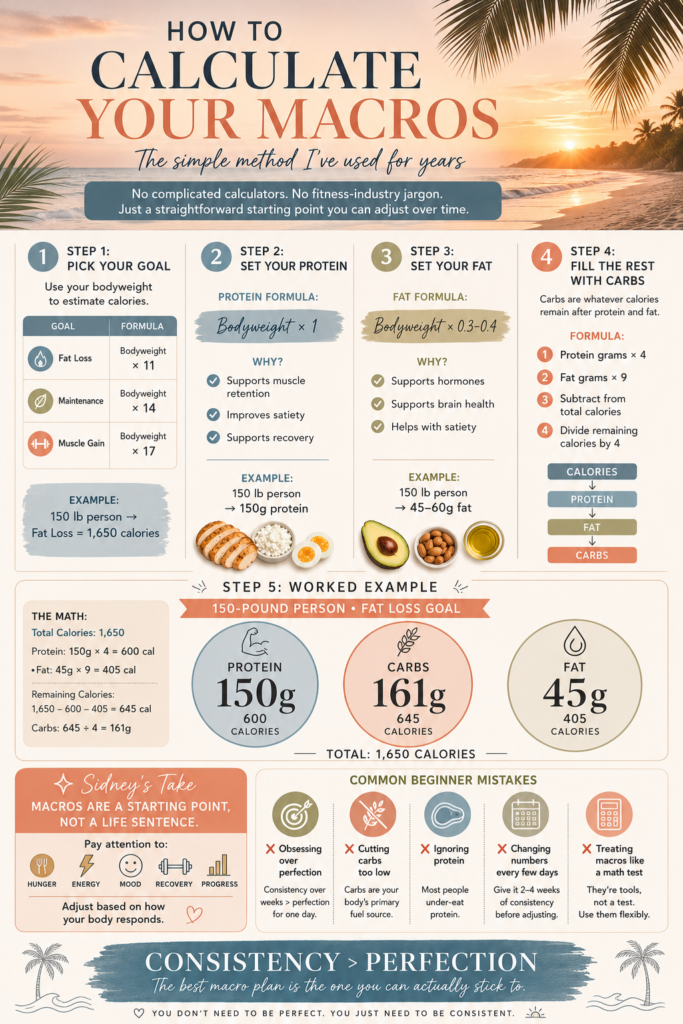
Step 1: Determine Your Daily Calorie Target
Start by estimating your daily calorie target based on your goal. Multiply your bodyweight in pounds by the appropriate number:
Fat Loss: Bodyweight × 11
Maintenance: Bodyweight × 14
Muscle Gain: Bodyweight × 17
150-pound example (fat loss goal): 150 × 11 = 1,650 calories
My personal numbers (fat loss goal): 128 × 11 = 1,408 calories
Disclaimer: My personal numbers are from the last time I was actively trying to lose weight. Right now I am pregnant so my calories and macros do not align here.
Step 2: Set Your Protein
Next, set your daily protein target. The method I use is straightforward:
Bodyweight (in pounds) × 1 = daily protein grams
This target sits at the higher end of commonly recommended ranges, which is intentional. Research consistently shows that higher protein intakes support muscle retention during fat loss, improve satiety, and support recovery. For most active adults trying to improve their body composition, 1 gram per pound of bodyweight is a solid working target.
150-pound example: 150 × 1 = 150g protein per day
My personal numbers: 128 × 1 = 128 g protein
✨ Sidney’s Take: “Protein is usually the first macro I focus on because it’s the one most people are consistently under-eating. Get this number right first, the rest follows.”
Step 3: Set Your Fat
Fat intake has a range built in, which gives you flexibility to adjust based on how your body responds:
Bodyweight (in pounds) × 0.3 to 0.4 = daily fat grams
150-pound example: 150 × 0.3 = 45g fat (lower end) | 150 × 0.4 = 60g fat (higher end)
My personal numbers: 128 × 0.4 = 51.20 g fat
The reason there’s a range here is important: your body will tell you where within that range works best for you. I’ll get into how to read those signals in the adjustment section below.
Step 4: Fill the Rest With Carbs
Once protein and fat are set, carbs fill the remaining calorie budget. Here’s how the math works:
1. Multiply your protein grams by 4 (protein has 4 calories per gram)
2. Multiply your fat grams by 9 (fat has 9 calories per gram)
3. Subtract both from your total calorie target
4. Divide the remaining calories by 4 (carbs also have 4 calories per gram)
Full worked example (150 pounds, fat loss goal):
Total calories: 1,650
Protein: 150g × 4 = 600 calories from protein
Fat: 45g × 9 = 405 calories from fat
Remaining: 1,650 − 600 − 405 = 645 calories for carbs
Carbs: 645 ÷ 4 = 161g carbs
Final macros for this example: 150g protein | 45g fat | 161g carbs
My personal numbers — full calculation:
Total calories: 1,408
Protein: 128 g × 4 = 512 calories
Fat: 51.20 g × 9 = 460.80 calories
Remaining: 1,408 − 512 − 460.80 = 435.20 calories for carbs
Carbs: 435.20 ÷ 4 = 108.80 g carbs
Step 5: Adjust as You Go
This is the part that most calculators leave out and honestly the part that matters most over time.
Your macros are a starting point. Once you have a baseline, your body will start to show you what’s working and what needs to shift. This is something I pay close attention to with my own numbers and it’s the most useful thing I’ve learned from years of tracking. ADJUSTMENTS MATTER.
A personal example: I’ve learned that I become noticeably more irritable when my carbohydrates are too low. I also tend to see better results with fat loss when I lower my carbs and increase my fats slightly (that’s why I use the higher range for fat calculation right off the bat, but I didn’t know this about my body before some test runs and I always used to do the lower 0.3). So I watch for those signals. A moody, low-energy day? I’ll lower my fat slightly to make room for more carbs. Noticing more bloating than usual? I’ll lower my carbs and give more space to fat instead.
I also have learned what tweaks need to be made to these particular, recommended numbers for my own calculations and my own body. These are all things you learn in time and feel naturally confident in adjusting for your goals.
Nothing is permanently set in stone. Our bodies change constantly, and the macros that worked perfectly six months ago might need adjusting today. That’s not failure, that’s just paying attention.

What If Your Macros Aren’t Working?
If you’ve been hitting your macros consistently for two to three weeks and something feels off, here’s how to think through it:
You’re constantly hungry: Increase protein slightly (it’s the most filling macro), make sure you’re drinking enough water (this can make a huge difference), and check whether your calories might be set too low for your activity level.
Your energy is low: You may need more carbs, especially if you’re exercising. Carbs are your primary energy source. Too few and your performance and mood often suffer.
Progress has stalled: Give any set of macros at least three to four weeks of consistent effort before adjusting (once you really learn your body, you can give it 2, that’s where I am at personally). Results take time. If you’ve been consistent and nothing is moving, a small calorie reduction (100–150 calories) or a slight shift in your macro ratios is a reasonable next step.
You hate the numbers: Macro tracking doesn’t work if it stresses you out more than it helps. If rigid tracking isn’t your style, use this method to understand your general targets and then practice hitting them loosely without obsessing over every gram. Awareness without obsession is still incredibly valuable.
📌 Good News: You do not need to track macros forever to benefit from learning them. Even a few weeks of consistent tracking can completely change how you understand your own nutrition.
Common Beginner Macro Tracking Mistakes
Treating macros like a math test. You don’t need to hit every number perfectly every single day. Being close, consistently, is far more valuable than being exact occasionally.
Obsessing over daily perfection. Consistency over the course of weeks and months is what produces results. One imperfect day changes nothing.
Think: 🥦🥗🥨🫑🥗🍕🥬🍩🍭🫐🍏
Not: 🥦🥗🥗🥝🫑🥑🥬🥗🫐🍏🥗
Avoiding carbs entirely. Carbs are your body’s primary fuel source. Cutting them too aggressively often leads to low energy, mood shifts, and an unsustainable approach. Trust me, no one wants to be around your cranky carbless ass lol. Carbohydrates make up the majority of daily calorie intake for most healthy adults.
Ignoring protein. Protein is the most commonly under-eaten macro. It matters more for body composition than most people realize. Hit this one first.
Constantly changing your numbers. Give your macros time to actually work before deciding they’re wrong. Adjusting every few days means you never have enough data to know what’s actually happening.
📌 Important: Macro calculations are estimates, not guarantees. Your starting numbers are a baseline to build from, not a formula that predicts exactly what your body will do.

✨ Sidney’s Take: “I’ve never believed nutrition has to be miserable to work. The best plan is the one you can actually stick to. If your macros feel impossible to hit consistently, they probably need adjusting, not more willpower.”
Frequently Asked Questions
Do I have to track macros to lose weight?
No. Many people lose weight without ever tracking macros. Macro tracking is simply one tool that can help create awareness and consistency.
Which macro is most important?
Protein is usually the first macro I focus on because it’s the one most people under-eat.
How long should I track macros?
Long enough to learn something. Some people track for years. Others only track for a few weeks before switching to a more intuitive approach.
Can I eat foods I enjoy while tracking macros?
Absolutely. Macro tracking isn’t about labeling foods as good or bad. It’s about understanding how those foods fit into your overall nutrition.
Final Thoughts
If you’re brand new to macros, I hope this showed you that they are a lot less intimidating than the fitness industry sometimes makes them seem.
At the end of the day, macros aren’t magic. They’re simply protein, carbs, and fat, the same three things that have always been in your food. Understanding them won’t automatically transform your health overnight, but it can give you a much clearer picture of how nutrition actually works. That’s where confidence starts.
I’ve used this method for years. I adjust as my goals change, I listen to what my body tells me, and I don’t treat any number as permanent. That flexibility is what makes it work long-term.
Start with your numbers. Track consistently. Pay attention to how your body responds. Adjust from there.
That’s the whole system.
If this helped you finally understand macros, save it or share it with someone who’s been too overwhelmed to start.

Sources
- Academy of Nutrition and Dietetics. “Essential Nutrients.” Academy of Nutrition and Dietetics.
- Lieberman, Harris R., et al. “Protein Intake Is More Stable Than Carbohydrate or Fat Intake Across Various Populations.” The American Journal of Clinical Nutrition, 2020.
- National Agricultural Library. “Food and Nutrition Information Center.” USDA, www.nal.usda.gov/programs/fnic.
- National Academies of Sciences. “Description of the Acceptable Macronutrient Distribution Range.” 2024.
- Wolfe, Robert R., et al. “Optimizing Protein Intake in Adults.” Advances in Nutrition, 2017.